“I have had a long adventurous journey of experience during which I saw multiple colors of life. There were challenges and trials which made me what I am today.”
Democracy had just spread its wings in Nepal, albeit belatedly, taking flight in the year 2008, May. The hearts of the Nepali people swelled with hope and compassion, envisioning a transformative revolution on the horizon, yet unaware of the trials awaiting them in the days ahead. The true worth of democracy, it became evident, lies not merely in its establishment, but in the stewardship of educated and enlightened citizens
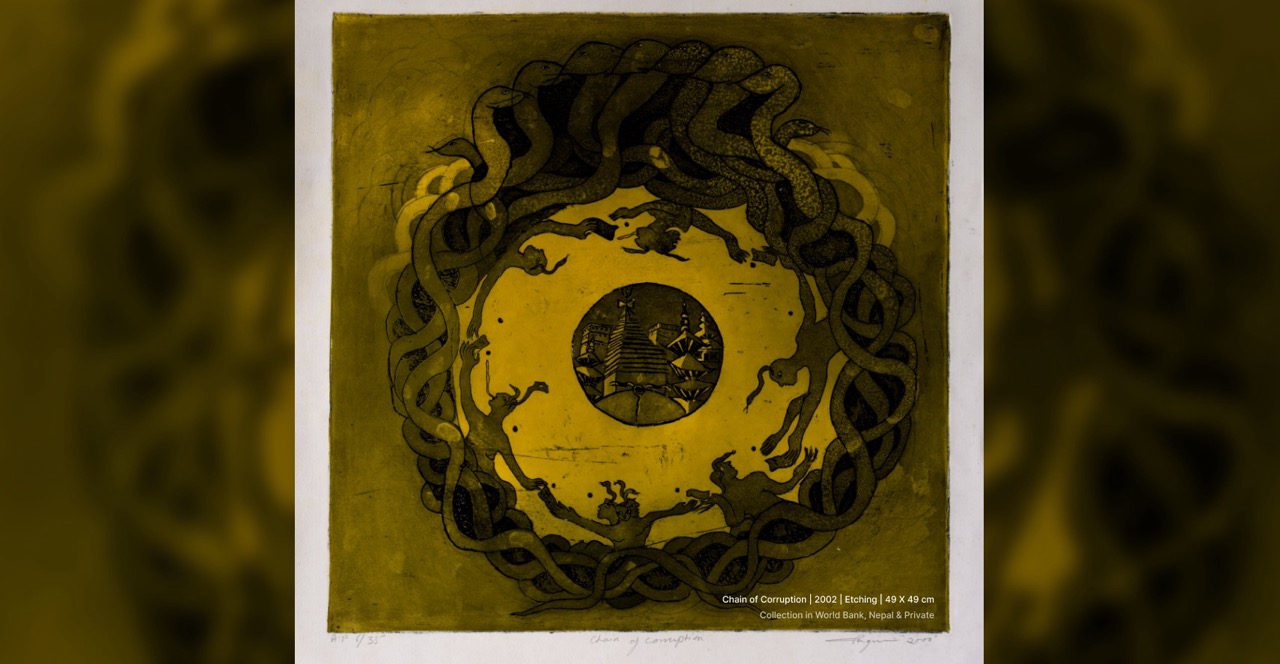
The Chain of Corruption : The Painting shows never ending cycle of bribes and exploitation.
The painting serves as a critique of the political establishment, highlighting the disconnect between the aspirations of the citizens and the actions of those in power. Through symbolic imagery and vivid colors, the artist captures the disillusionment and frustration felt by many Nepalis during this time of political upheaval.
"सुँगुरको मुखमा स्याऊ"
Translated as : Apple in Pig's Mouth.
This metaphor can be applied politicians who have been entrusted with the welfare and prosperity of their country but have squandered or misused that trust for their own gain, rather than serving the interests of the people
Nepal Unveiled: An Artistic Lens on the Nation's State of Political Affairs
“Democracy is a government of the people, by the people and for the people.”
-Abraham Lincoln, 16th President United States
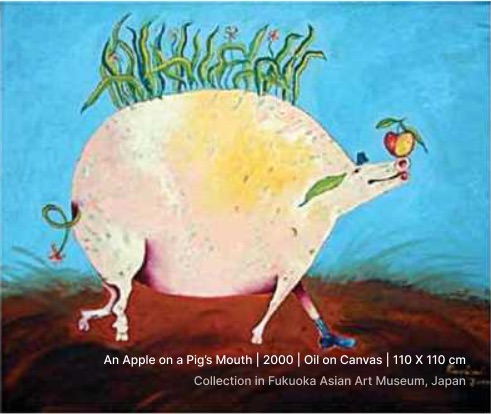
Collection in Fukuoka Asian Art Museum, Japan

Women | 79 x 110 cm | Oil on Canvas | Collection on Fukuoka Asian Art Museaum | Fukuoka Japan | 1999.
The Cow
Represents the greatness and nurturing qualities of women, drawing from Hindu mythology where the cow is a revered, holy being.Peacock Tail
Signifies dreams and aspirations, highlighting the inner desires and potential of women.Lotus Breast
Symbolizes purity, beauty, and resilience, emphasizing women’s inherent strength and grace.Nature Elements in Legs
Illustrates women’s ability to endure and thrive through hardships, symbolized by natural elements.The Face and Lock
Depicts the constraints women face, represented by a lock, indicating societal and self-imposed limitations.The Key: Represents the power women have to unlock their potential and overcome barriers, emphasizing self-empowerment.
The series includes Shadow of Love and Women Power that are part of my own odyssey- Love, Power and Politics

Ragini Upadhyaya has long been regarded for her keen observation of the societal landscape, channeling the essence of her surroundings into poignant artistic expressions. Throughout her odyssey phase, she meticulously crafted artworks that served as mirrors to the prevailing issues of her time. Her pieces vividly portrayed the hubris inherent in political power, laying bare the self-serving nature and heedless exploitation of the nation’s resources by those in positions of authority. Aptly named “Nepal Story,” her paintings during this period served as both a critique and a chronicle, capturing the essence of a nation grappling with the consequences of political arrogance and neglect.
Words from Maurice O'riodan (An Australian Freelance Art Writer)
The timelessness to which Queen refers in the The Myth of Politics relates not only to human politics but also to rudimentary forms, suitable layering of hand prints and colors absorption into handmade paper which evoke the aura and vitality of ancient rock art. It would be wrong, however, to think that Upadhyay Grela’s paintings only offers a “bemused” response to political life. The symbols in her narrative revel a far more profound and poetic investigation. “Being part of the more contemporary art scene has no doubt given the humanism of her work greater scope, opening it up to varying mode of expression.”
Source: Maurice O’riodan | Asian Art News, Hongkong, China | July – Aug, 1995.

