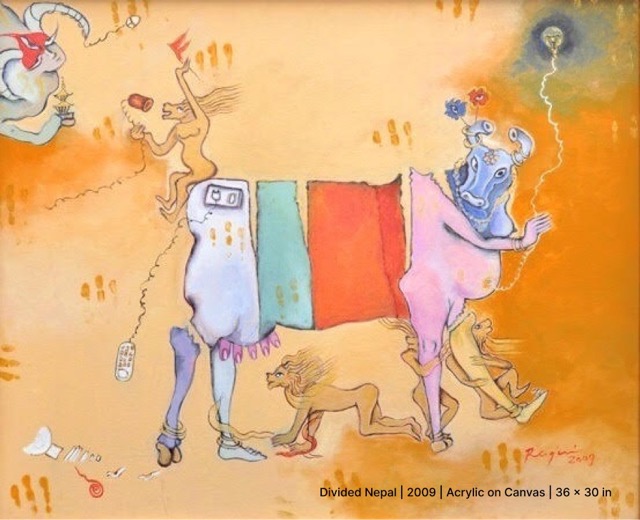
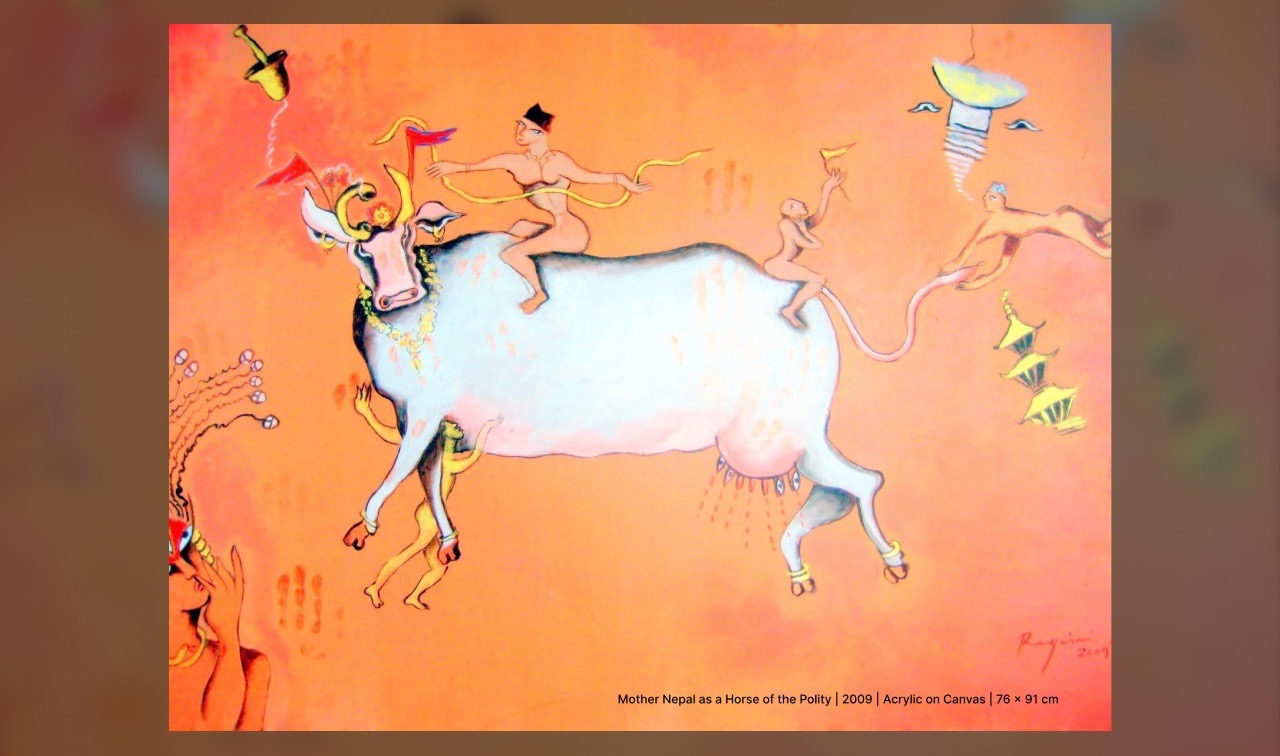
Gaijatra, is a traditional festival celebrated in Nepal, particularly by Newar Community. The festival is celebrated for commemoration of the dead. During the festival, people are encouraged to dress up ridiculously similar to cow and perform music, dance or tease. People also mock social and political issues, poking fun at authorities and societal norms. The tradition dates back to the reign of King Pratap Malla, who encouraged humor and satire to console his queen after the death of their son.
Chaos and Canvas: Ragini Upadhyayay's Artistic Reflection on Nepal's Turbulent Times
The Gaijatra Series, created in 2010 by the renowned artist Ragini Upadhyayay, is a powerful and evocative collection of paintings born out of a period of intense political turmoil in Nepal. This series is deeply rooted in the ethos of the Gaijatra festival, a unique celebration that combines cultural traditions with deep devotion. Known for its unconventional mix of rituals, the festival also serves as a platform for social and political commentary, often using satire to highlight and ridicule the actions of the powerful.
Ragini Upadhyayay’s Gaijatra Series is a parody of the political chaos that gripped Nepal at the time. Through her art, she offers a sharp critique of the power-hungry politicians, capturing the absurdity and farcical nature of their actions. Each painting in the series is a masterful blend of humor and critique, reflecting the artist’s keen observations and deep understanding of the Nepal’s status during that time.
Nepal's Turbulent Era (2009-2010): A Reader's Guide to Understanding the Art of Ragini Upadhyayay
Taste of Chair | 2009 | Acrylic on Canvas | 91 x 76 cm | In a Private Collection, Nepal
“TASTE OF CHAIR”
In this painting from Ragini Upadhyayay’s “Gaijatra Series,” a fantastical creature embodies the corrupt nature of politicians.
Chair on Tongue: The chair perched on the creature’s tongue symbolizes the politicians’ relentless quest for power, always speaking of authority.
Snakes as Hair: The snakes represent the deceitful and treacherous actions politicians take against one another to maintain or gain power.
Cow in the Stomach: The cow, a symbol of Nepal, depicts the nation being consumed and exploited by these power-hungry leaders.
Growing Creature: While the grotesque creature grows in strength, symbolizing the increasing greed and corruption, the scattered flags indicate the nation’s decline and instability.
This powerful metaphorical artwork critiques the political scenario in Nepal, highlighting the detrimental effects of greed and corruption on the country and its people.
STATS AND FACTS
Summary of the Chaos: Nepal (2009 - 2010)
Nepal embraced democracy in 2008, emerging from a long period of monarchy. However, the political leaders, adept with words and arms, struggled to lead effectively. Between 2009 and 2010, Nepal faced numerous challenges. Daily news depicted political leaders fighting for power, undermining the essence of democracy, which was intended for the people. Instead, leaders were consumed by greed, causing government instability. Resignations, constitutional deadlock, and violent Maoist protests characterized this chaotic period, leaving citizens terrorized and disheartened.
In this tumultuous environment, Ragini Upadhyayay, a perceptive artist, felt compelled to illustrate the absurdity of the political situation. This inspiration gave birth to her series, “Gaijatra,” capturing the satirical essence of the era’s political comedy.
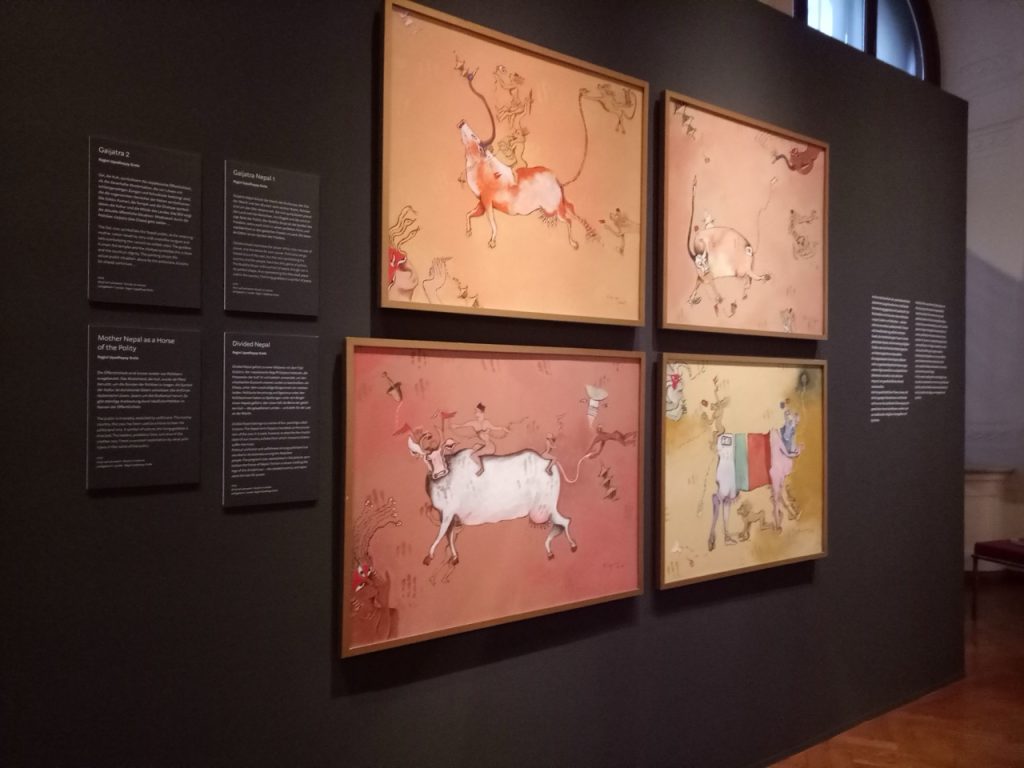
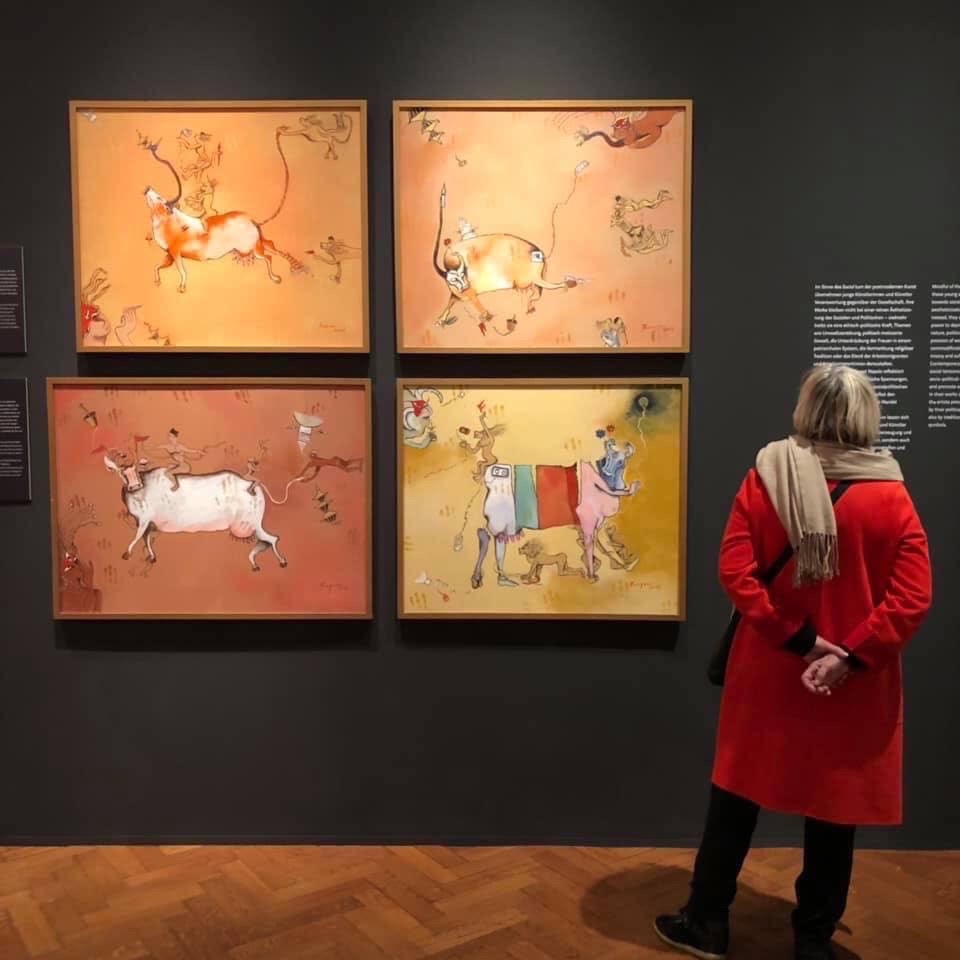
Artworks from “Gaijatra” series being displayed on Nepal Art Now 2019 , Welt Museum, Vienna , Austria
PERSPECTIVE
Spectator's Remarks on the Art of the Gaijatra Series
“The Gai (Cow) symbolizing Nepal as the enduring mother nation, but beset by lions with snake-like tongues and tails,symbolizing the so-called rulers of the nation and the Goddess Kumari, temples and Chaityas symbolizing the cultural dignity of our country make up most of her paintings. She continues to use many flying or suspended images, and with the additional sense of Gai Jatra, her subjects are even more topsy-turvy than usual. There are tons of symbolic images on a single canvas, and that is what keeps you pulled in.”